
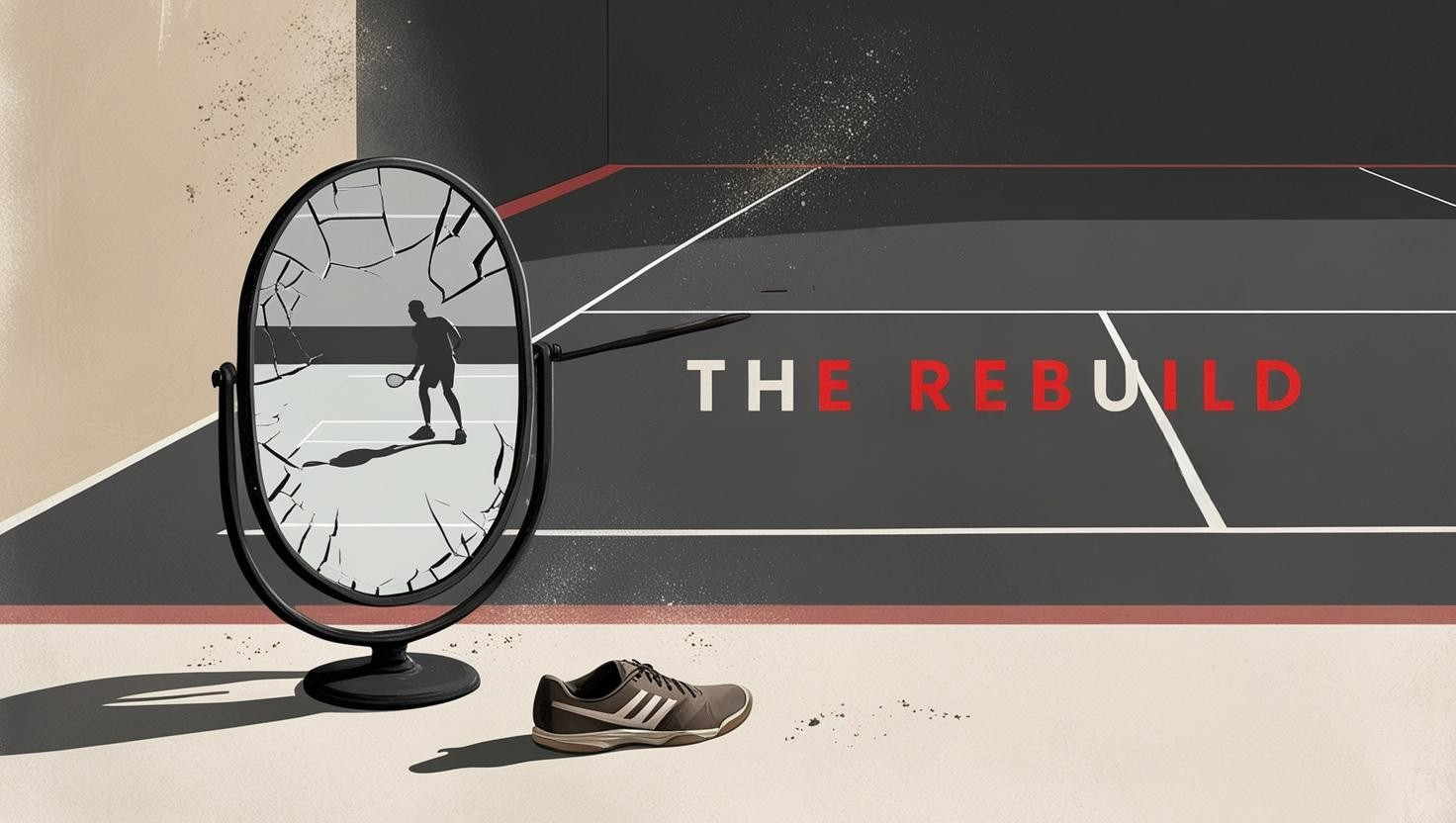
There’s a point when the game stops being a game and becomes a mirror. Not some metaphorical mirror—but a blunt, jagged, cracked piece of glass held up to the face that forces you to look. To really look. And all you see is how far you’ve drifted from the thing you once were.
This is that point for me.
The tournament is over, and I finally have enough distance from it to sit down and accept what it really was: a slow unraveling. Not a collapse, not a blowout—just an unraveling of who I thought I was, and who I actually walked out onto the court as. There’s no villain to point to. No wind to blame. No paddle to curse. Just me. Unprepared, unfocused, undisciplined. And painfully aware of it.
I didn’t lose because of a lack of skill. I didn’t lose because of fear. I lost because I stopped doing the work. I stopped pressing. I took my foot off the gas months ago, and the game has a brutal way of reminding you when you do that. This wasn’t about technique. It wasn’t about strategy. This was about execution—and the absence of it.
At one point, I felt dominant. Maybe I wasn’t winning every match, but mentally? You couldn’t tell me I wasn’t the best player on the court. Now? I don’t feel like I belong in the top tier. My movement is gone. My explosiveness is gone. My body is trailing behind my mind, and my paddle feels foreign in my hand. It’s not excuses—it’s accountability. Every time I ignored the little things, every time I let my environment dictate my work instead of the other way around, this version of me was being built.
So, now there’s only one option left: Rebuild.
From the ground up. Start over—not metaphorically, but in real moments of situational work, real sweat, real reps inside unglamorous repetition. This means treating myself like I’ve never played this game before. Like I don’t know how to lob, how to reset, how to counter, how to read a bounce. Because right now, it doesn’t matter what I used to know. What matters is what I’m willing to build back.
Phase One: The Body
First, I have to earn my legs back. That’s not poetic—it’s literal. Conditioning. Strength. Weight. Agility. Everything starts from the ground up. Then comes the upper body—developing again the kind of force that can finish a point or counter one. And when the body starts to remember, I’ll begin reshaping the game plan.
Phase Two: Rewriting the Book
The game plan will be rebuilt with intention. Not vague ideas or random hitting sessions, but deliberate situational frameworks:
- I’ll hire players whose only job is to speed up at me relentlessly, over and over, so I can return to what I do best: counter.
- I’ll write out detailed cards: “Target my backhand. Treat me like a player with no tennis or baseball background. React as if I have no reflexes.”
- I’ll find a player who loves dinking more than I ever did. I’ll set 5-minute, 10-minute, 30-minute clocks just to sit in the monotony. And wait. And work.
That’s where the rebuild begins—in boredom. In routine. In the honest reality that what makes a great player isn’t flash. It’s consistency in uncertainty.
Phase Three: The Middle of the Court
This is my favorite space. That first transition from baseline to upper third. Then, holding ground. Seeing a high ball and deciding—do I reset, counter, pop, flick, lob? Do I wait for the next ball to rise so I can finally step in?
These aren’t decisions you get to think through in a match. These are movements that must become instinct. And right now? My instincts are off. So I’m rebuilding them too.
Clarity in Uncertainty
Every situation will have a purpose. Every practice session will have a clear line: “This is a situation.” “This is open play.” “This is uncertainty.” Everyone involved will know the expectation. There will be no hiding behind miscommunication. Because at the level I want to play, there’s no place for players who hesitate. Everyone can hit. Everyone can move. The only real question is—can you adapt? And can your partner dance with you when the music changes mid-point?
Phase Four: Rebuilding the Team
I don’t have the same group around me that I did before. No one’s waiting on me. I have to go build it again. From scratch. From dust. New training partners, new tempo, new expectations. It won’t be fast, and it won’t be perfect. But it’ll be real.
Because here’s the truth: if I’m not lifting, not shocking, not expressing physically or mentally through this game, then I don’t deserve to be in it. Not at the level I claim I want to play. If I’m just showing up, if I’m not refining and reflecting, then I’m just wasting time. And I’d rather be honest enough to quit than lie my way through another week of “almost.”
But I’m not quitting. Not yet. I’m going to give it one more swing. One more shot to rebuild everything from the ground up.
If it works, it works.
If it doesn’t—at least I’ll know I walked the entire path again.
And that? That’s enough for now.
Leave a Reply